

Revelation: Given to Christ by God the Father to Show His Servants the Things that Must Take Place
John on Patmos & the Ephesus Church Period (96-170 AD)
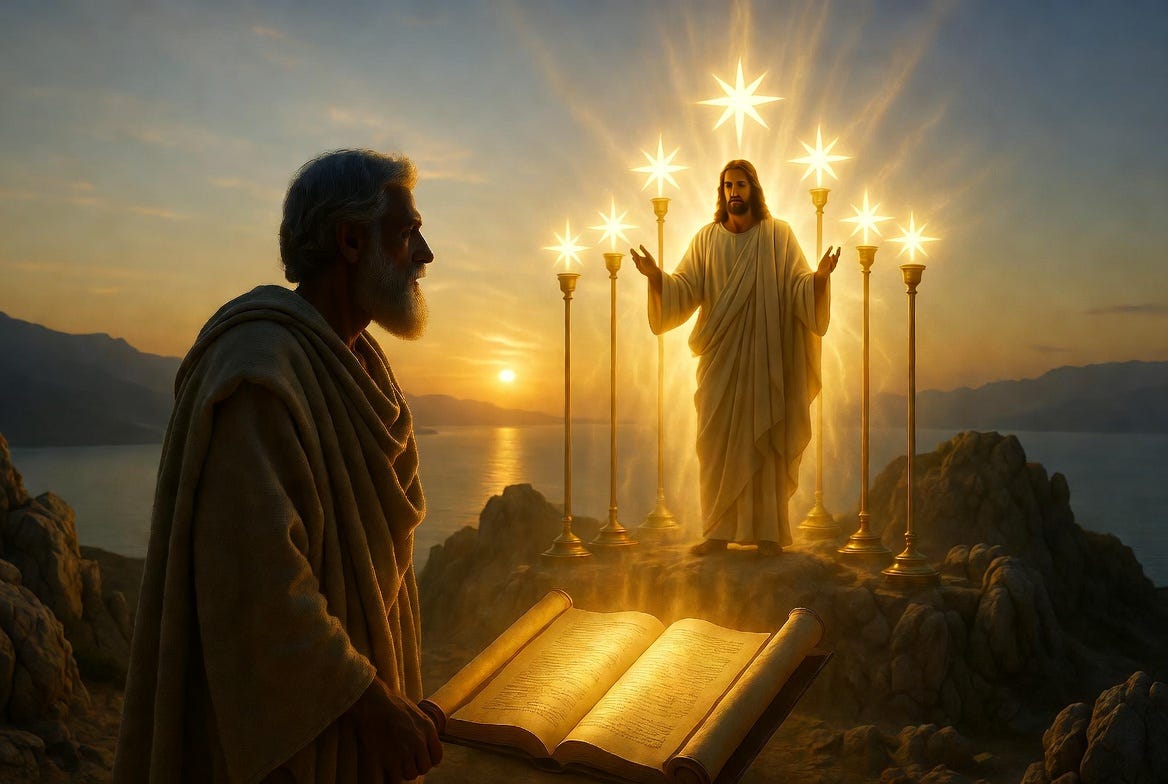
John Receives the Revelation from the Lord (Revelation 1:9–20)
John was on the island of Patmos when he received the revelation (Revelation 1:9).
Patmos is a small volcanic island in the Aegean Sea.
Patmos is approximately 37 miles from Miletus (Present day Turkey).
Patmos is not specifically names as a penal colony in extra Biblical material.
The rugged terrain and isolation made it an ideal place for imposing banishment that did not include lose of citizenship or property).
John was on the island because of his testimony of Jesus Christ
John was in spirit on the Lord’s day (Revelation 1:10).
“In spirit” refers to his human spirit, not the Holy Spirit.
It indicates he was deep in rational thought.
We worship God in spirit and truth (John 4:23–24).
The Jew who is circumcised in the heart, in spirit (Romans 2:29).
The restoration of a brother while being in a spirit of objectivity (Galatians 6:1).
The Lord’s day is Sunday: the first day of the week (Luke 24:1).
John is instructed to write what he sees (Revelation 1:10–19).
He hears aloud voice declaring Himself as God.
John is instructed to write to the seven churches (Revelation 1:11).
The seven assemblies represent the seven periods of the Church on earth.
The seven golden lampstands represent each assembly (Revelation 1:12).
John describes the One speaking to Him (Revelation 1:13–15).
The One speaking to John is holding seven stars: the seven pastors of the seven assemblies (Revelation 1:16).
John falls before the One speaking to him (Revelation 1:17).
The One speaking to John is Jesus Christ (Revelation 1:18).
Jesus now possesses the keys of Hades and death.
Through Jesus’ death, Satan’s authority over death was stripped from him (Hebrews 2:14).
John is instructed to write (Revelation 1:19).
The Mystery of the Seven stars and the seven lampstands (Revelation 1:20).
The seven stars are the messengers of the seven assemblies.
The seven lampstands are the seven assemblies.
The Seven Periods of the Church on Earth (Revelation 2:1–3:22).
Each of these assemblies represents the predominate condition of the Church on earth at different periods of it existence.
All of the assemblies already exist.
The only assembly that no longer exists today is the Ephesus assembly (Revelation 2:5).
The history of the Church reveals that these assemblies are referring to seven periods.
These time periods begin shortly after the Apostolic period.
The Ephesus Assembly (Revelation 2:1–7)
The Churches belong to God (Revelation 2:1).
Paul taught the saints in Ephesus the entire counsel of God (Acts 20:27).
Paul warned the assemble what would happen when he was gone (Acts 20:28).
John writes to the pastor of the assembly (Revelation 2:1).
Christ knows their works, labor, and patience (Revelation 2:2).
This assembly does not tolerate wrong (Revelation 2:2).
After the twelve apostles, many false ones came. This assembly exposed them for being liars (Revelation 2:2).
Their testing was to cause these false apostles to fail (Revelation 2:2).
The requirements for an Apostle.
Chosen by Christ, Himself (John 15:16).
Had to have seen Christ while He was on earth (Acts 1:21–22).
Had to have witnesses the resurrection; seen Christ after His resurrection (Acts 1:22; 1 Corinthians 15:8).
There are only twelve Apostles for the lamb (Revelation 21:14).
Paul is the twelfth (1 Corinthians 15:8–9).
They tolerated and had patience, laboring because of Christ’s name (Revelation 2:3).
They lost their first love (Revelation 2:4).
This is the love of fellow saints (John 13:34; 1 John 4:21).
Their focus was on dealing with false apostles, not loving the brethren.
This lost of love is manifested in an indifference for fellow saints (1 John 4:20).
They are instructed to return from where they have fallen (Revelation 2:5).
Their first work is to love the brethren.
Without love, there is no value to their works (1 Corinthians 13:1–3).
If they do not change their mind, Christ will remove their lamp stand from it place (Revelation 2:5).
This is the only assembly that is removed.
Due to their failure to change their mind, this assembly is no longer present on the earth.
The were indifferent to the works of the Nicolaitans (Revelation 2:6).
The Nicolaitans are those who seek victory over the people.
The doctrine of the Nicolaitans is the separation of the clergy from the assembly.
The reward for those in the assembly who are overcomers (Revelation 2:7).
The overcomer is the one who believes the gospel for salvation (1 Corinthians 15:3–4; 1 John 5:4–5).
They will partake of the fruit of the tree of life in the paradise of God (Revelation 2:7).
Paradise is at the edge of the third heaven (2 Corinthians 12:2–4).
The Church saints who have passed away reside in the third heaven in the presence of God (2 Corinthians 5:8).
These saints will have access to the tree of life to sustain their physical bodies.
They do not possess a resurrected body or save soul
All church saints will be resurrected at the same time (1 Thessalonians 4:15–17).
The soul is last part to be saved (1 Peter 1:9).
When we see Christ, we will be like Him (1 John 3:2).
This assembly represents the predominate condition of the Church from AD 96 to 170.
The Church as a whole was being impacted by false apostles.
Even during the Apostolic Period many false apostles were present (2 Corinthians 11:5-they called themselves the eminent apostles).
Paul taught for two years at the school of Tyrannus in Ephesus (Acts 19:8–9).
Paul remained in Ephesus for three years (Acts 20:31).
Timothy was sent by Paul to oversee the assembly to charge them concerning those who were bringing in different teachings (1 Timothy 1:3).
Church history indicates John resided in Ephesus after his return from Patmos.
By AD 614 the Christian community was no longer present in the city.
Under Onesimus they began to dimension.
Ignatius of Antioch wrote about the assembly under Onesimus.
Under Onesimus, the assembly focused on orderly conduct, truthfulness, and freedom from heresy.
By the early second century under Polycrates, the assembly was completely lost.
He was known for defending the tradition of observing the Passover on the fourteenth day of Nisan; rather than on the following Sunday.
He resisted the western influence of Rome on the Church.
Join us in person at 811 W. Main Street in Monroe, WA 98272.
If you are unable to join in person, we will have a live broadcast of Evening School of the Bible at 6:00 PM.
And let us consider one another in stirring up love and proper works, not forsaking the gathering of ourselves, just as is the habit of some, but encouraging, and so much more as we see the day approaching (Hebrews chapter 10:24–25).
In a world that often pulls us toward isolation, coming together face-to-face provides encouragement, clarity, and spiritual strength. At Word of Grace Studies, we gather because we value the opportunity to build up one another in truth, to stir up love and proper works, and to grow together in the faith. Whether you can come and fellowship with us or at a local assembly in your area, do not forsake the assembling of the saints, your presence matters—for your benefit and for the encouragement of others.
You’re always welcome to join us and experience the encouragement and connection that come from gathering together.